A SLAM system automates the last few feet of fulfillment, the point where a packed carton becomes a shippable, trackable parcel. Instead of an operator hand-keying weights, printing labels, and sorting by carrier, the line does it in one continuous motion.
Each letter in SLAM is a distinct step, and SLAMPoint handles all four in a single pass:
1. Scope the configuration. We confirm your carton mix, carrier requirements, throughput target, and whether you need add-ons like a scale and dimensioner.
2. Factory build and test. The unit is assembled, wired, and commissioned in our facility using proven controls and software, then run and verified before it ships.
3. Deliver and connect. SLAMPoint arrives pre-aligned. It is positioned, connected to power, and tied into your packing stations or conveyor, often in a few hours.
4. Run and support. The machine is built to perform from day one, with remote monitoring and the same team that built it standing behind it.

Moves with you - relocates to the next warehouse when a contract or location changes, instead of becoming a stranded asset.

Stands alone or integrates - runs as a standalone station or controls conveyor you already have.

Scales by the unit - add machines per dock door, carrier, or zone as volume grows.

Expands as needs change - add a scale, dimensioner, or sorter now or later.
Traditional SLAM lines are complex, time-consuming, and usually require coordination across controls, software, and installation vendors. That complexity is exactly what SLAMPoint removes.
Because the unit is built, wired, aligned, and tested in our facility before it ships, there is no multi-week field build and no multi-vendor finger-pointing. A conventional system might take a week or two to install on-site. SLAMPoint is pre-assembled and pre-commissioned, so it typically goes from delivery to running in a matter of hours, not weeks.
It is also priced to fit operations that were previously shut out of automation. A comparable built-in-the-field unit can run around 100,000 dollars; a factory-built SLAMPoint deploys closer to the 70,000 dollar range, with the labor and risk of on-site construction taken out of the equation. For a single-station operation, that one machine can do the work of four to six people on the pack line. Financing and leasing plans are available as well, so a unit can go in without a large upfront capital outlay, which matters most to the shorter-term, lease-driven operations SLAMPoint is built for.
If your team is staring down a volume spike and a six-month automation timeline that will not make it, a factory-built SLAM unit is worth a conversation.
SLAMPoint is not a box sourced from a catalog and dropped at your door. It is engineered, assembled, and supported by the same team that designs and installs full automation systems, which is why it fits cleanly into whatever you already run.
And when a project does not fit SLAMPoint, whether the carton sizes or the required rate fall outside its range, we will tell you and point to the right print-and-apply or turnkey conveyor solution instead. The goal is the system that fits your operation, not forcing one product onto every floor.
SLAM stands for the four automated steps a carton goes through before shipping: scanning the barcode, generating the shipping label, applying that label to the carton, and manifesting it, meaning creating the carrier shipping record. SLAMPoint performs all four in one continuous pass and can sort the carton afterward.
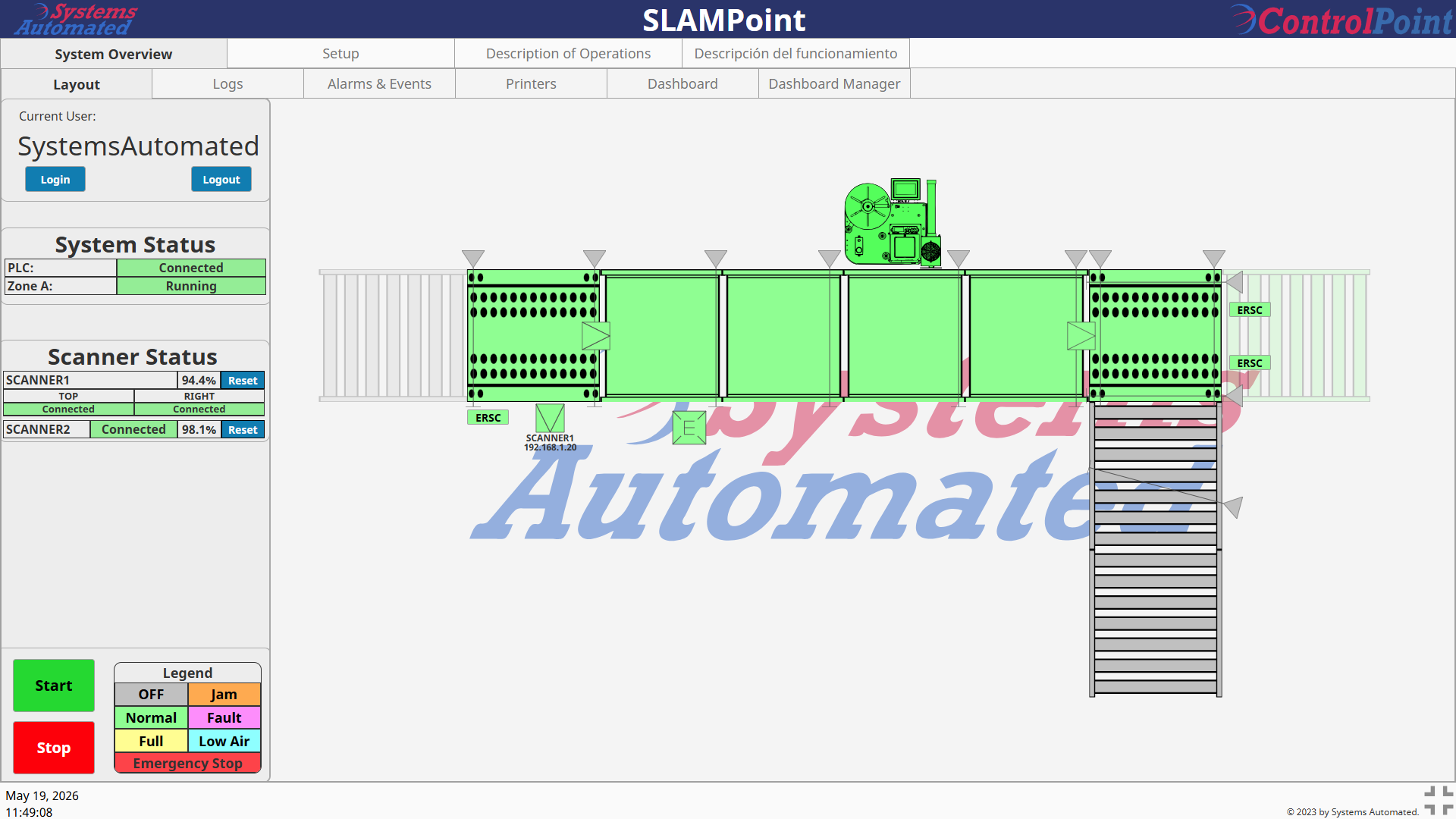
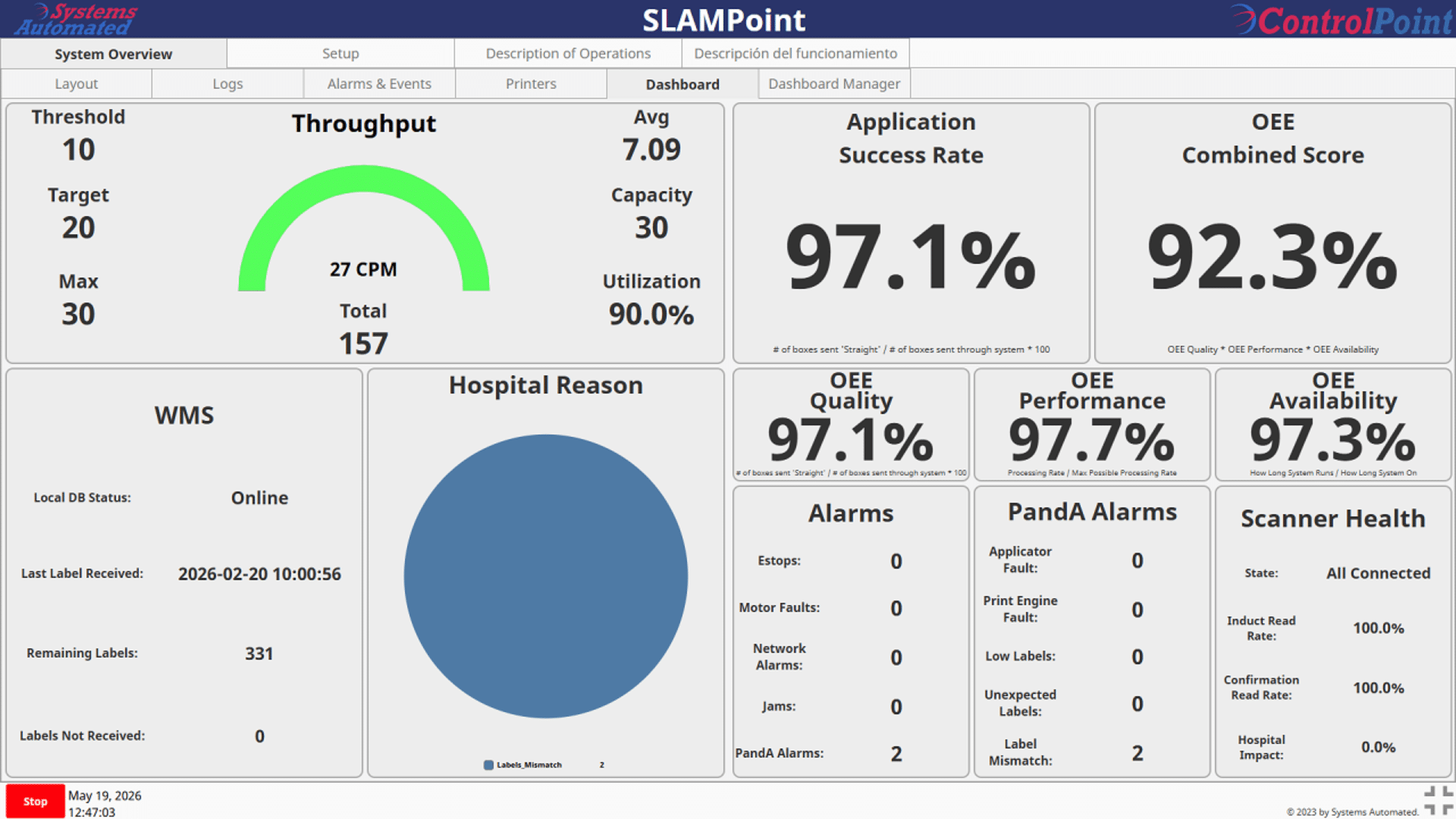
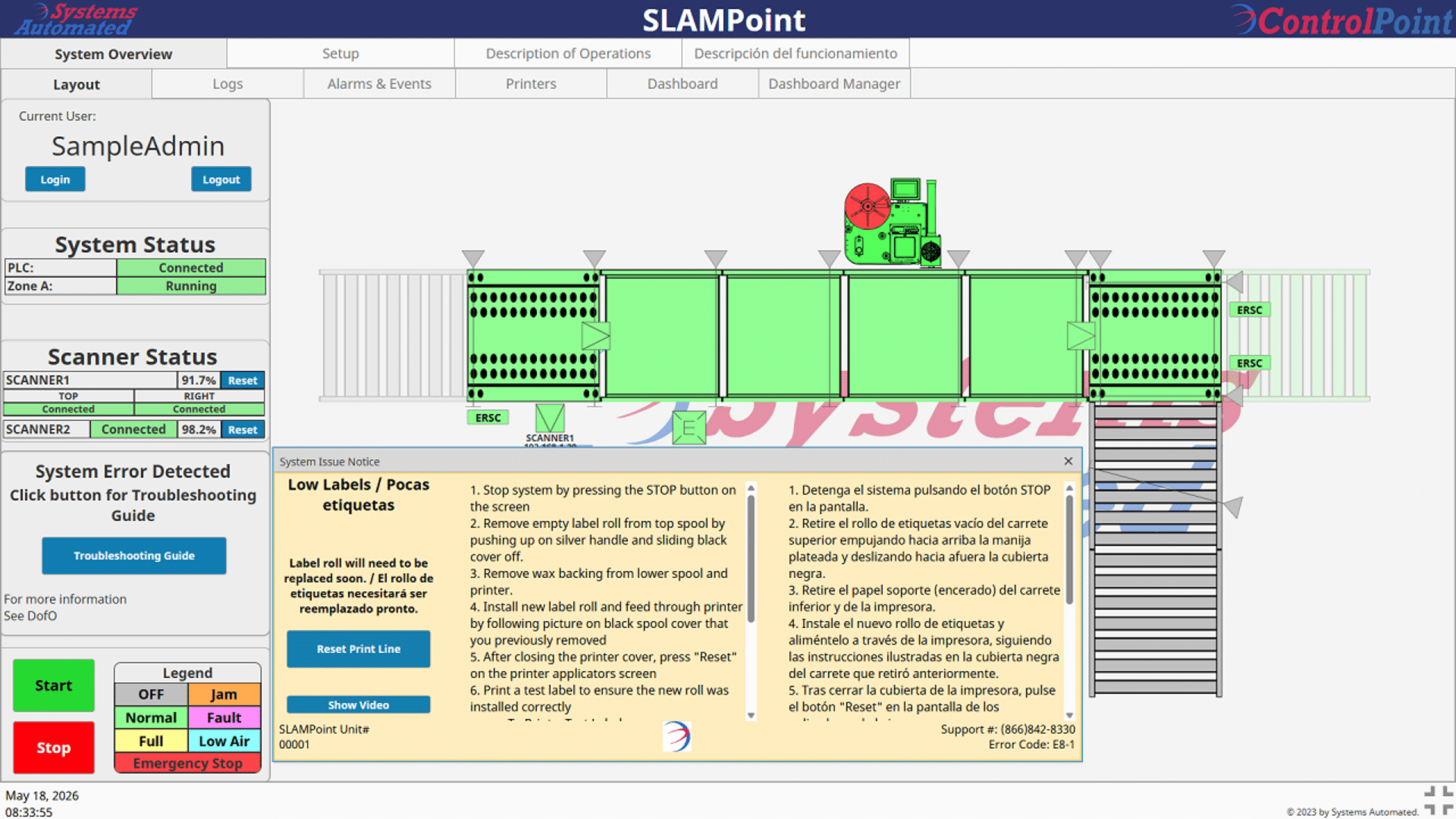
Every SLAMPoint runs on our ControlPoint software, so operators and managers see exactly what the system is doing in real time. The layout screen shows live status for each zone, scanner, and printer, with a simple color legend for normal, jam, fault, and low-label conditions, so a problem is visible at a glance. The dashboard tracks throughput, application success rate, and a combined OEE score, alongside WMS connection status, remaining labels, and scanner health. And when something needs attention, the system surfaces a step-by-step troubleshooting guide, in both English and Spanish, right on the screen, so your team can resolve common issues like a label change without waiting on a call. It is the same reporting and visibility layer that runs our larger warehouse systems, built into the unit.
Because SLAMPoint is built, aligned, and tested in the factory before delivery, it does not require a multi-week on-site build like a traditional SLAM line. In most cases it is positioned, connected to power, and running within hours of arrival rather than weeks.
A single SLAMPoint unit can take the place of roughly four to six people on a manual pack-and-ship line, depending on your throughput and carton mix. It handles cartons from about 9 by 6 by 1 inches up to 28 by 24 by 24 inches and up to 50 pounds, across boxes, polybags, and flats, which makes it flexible across different order profiles.
No. SLAMPoint can run as a standalone station where an operator loads and unloads cartons by hand, which makes it practical for operations with limited existing automation. A companion configuration can instead control zones of conveyor you already run, so you can add SLAM to an existing line rather than build a new one.
Yes. Many operations run multiple units across a facility rather than in a single line, for example one per dock door or carrier, or separate units for ecommerce and retail zones. Because each machine is self-contained and movable, scaling up is a matter of adding units where the volume is.